



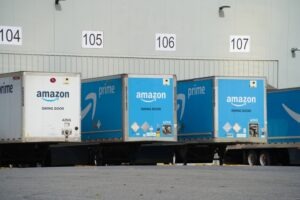
If you were struck by a vehicle sporting the recognizable Amazon logo on a Lafayette residential street or involved in a collision with a large Amazon freight truck on I-65, you might assume your legal path to justice is a straightforward claim against a multi-billion-dollar corporation.
However, the reality of Amazon delivery truck accident litigation is an intricate web of subcontracting, technical data retrieval, and specialized insurance layers that make these cases some of the most complex in the modern personal injury landscape.
While the van may appear to belong to the e-commerce giant, the legal entity that may be held responsible for your medical bills and property damage is often a hidden third-party company designed to shield the parent corporation from liability. Let’s dig deeper into the complicated legal arguments that may affect an Amazon truck accident.
Key Takeaways About Amazon Delivery Truck Crashes
- The Subcontractor Defense: Most Amazon “last-mile” deliveries are performed by Delivery Service Partners (DSPs), which are independent small businesses that often lack the massive financial resources of Amazon, creating immediate hurdles in recovering the compensation needed after a crash.
- Algorithmic Pressure: High delivery quotas and strict telematics monitoring can lead to driver fatigue and reckless maneuvers. Proving this connection requires access to digital evidence and the ability to connect the evidence.
- Insurance Tiering: Depending on whether the driver was an Amazon Flex contractor or a DSP employee, different insurance policies—ranging from personal to high-limit commercial—may overlap, necessitating a comprehensive analysis of coverage hierarchy.
- Rapid Evidence Degradation: Data from onboard monitoring systems (such as Netradyne cameras) can be overwritten or lost within a matter of days if a legal preservation demand letter is not issued immediately.
Your Case Will Get
The Attention It Deserves

The Amazon Branding Mirage: Who Is Actually Liable For Your Accident?
The primary reason Amazon delivery accidents are so complicated is the Delivery Service Partner (DSP) model. Amazon rarely employs the drivers of the Amazon Prime blue vans you see on local roads like Creasy Lane or South Street. Instead, Amazon contracts with thousands of small, independently owned limited liability companies (LLCs) known as DSPs—making it critical to work with an experienced truck accident lawyer who understands how to untangle these layered liability issues.
When a collision occurs, Amazon’s standard legal defense is to claim it has no employer-employee relationship with the driver. By classifying these drivers as employees of a DSP, Amazon creates a buffer of legal separation.
For an injured crash victim, this means you are often filing a claim against a small local business that may only own a dozen vans, rather than the corporate giant itself. Identifying whether Amazon exercised “legal control” over that driver—a legal standard required to hold the parent corporation liable in the lawsuit—is an uphill battle that requires an intensive investigation into the specific contracts and daily oversight between the DSP and Amazon.
The Impact of High-Stakes Metrics and Algorithm Distraction
Unlike a standard delivery service, Amazon drivers are governed by a sophisticated algorithm that monitors their every move. Through an app known as The Rabbit and onboard cameras like Netradyne, drivers are tracked on their driving speed, braking habits, seatbelt usage, and, most importantly, their delivery speed.
The Quota Problem
Drivers are often pressured to deliver hundreds of packages in a single shift. In a busy urban area like West Lafayette or near the Purdue University campus, this pressure frequently leads to:
- Illegal Parking: Double-parking on narrow streets to save time can lead to rear-end and side-swipe collisions.
- Reckless Reversing: Quick backing maneuvers to find a location or when leaving a residential driveway can cause a crash.
- Driver Fatigue: Exhaustion from long shifts and high physical demands can significantly slow reaction times and may lead to an accident.
While these telematics systems are marketed as safety tools, the data they collect can also prove the driver was rushing or distracted at the time of the crash. However, this data is proprietary. Gaining access to the GPS coordinates and safety events recorded by the van’s computer requires sophisticated legal maneuvers that go far beyond a standard insurance demand.



Navigating the Hierarchy of Insurance Coverage
 Depending on the specific type of Amazon delivery vehicle involved in your Lafayette accident, the insurance coverage can vary wildly.
1. Amazon Delivery Service Partners (DSPs)
Most Amazon-branded vans are covered by commercial insurance policies required by Amazon. These policies generally have higher limits than a standard driver’s policy—often $1 million or more—but the insurance adjusters for these commercial carriers are notorious for their aggressive defense strategies.
2. Amazon Flex Drivers
Many deliveries are made by Amazon Flex drivers who use their personal cars to get around town. These drivers are pure independent contractors. While Amazon provides some supplemental liability coverage for Flex drivers while they are on the clock, that coverage only applies after the driver’s own personal insurance has been exhausted or if the personal insurer denies the claim.
Since many personal auto liability policies in Indiana have an express exclusion for commercial or delivery use, a crash victim can easily find themselves trapped in a coverage gap situation where neither insurer accepts responsibility for the harm suffered.

Local Risks: Amazon Logistics in Tippecanoe County
Lafayette has experienced a significant increase in delivery traffic due to its proximity to major distribution centers and growing population. Amazon vans are a frequent sight on bypasses like US-52 and the residential clusters around McCutcheon High School and the Harrison High School districts.
The accident risk is especially high in residential areas where drivers may not be familiar with the local layout. Because these drivers are often from out of town and rely entirely on GPS, they are prone to making sudden U-turns or pulling out from a curb without checking for approaching bicycles or pedestrians. In these cases, our local Lafayette roads become the backdrop for complex disputes over who had the right of way, as well as Indiana’s specific negligence statutes.
The Challenge of Data Preservation
In a modern Amazon truck accident, the most important witness often isn’t a person—it’s the vehicle’s data. Amazon’s vans are essentially mobile sensors. They record:
- Speed at the time of impact.
- Internal and external camera footage from the Netradyne cameras that many trucks use.
- Braking and acceleration force.
- Smartphone or app interaction in the seconds before a crash.
However, corporate entities have internal policies regarding how long this data is stored. Without a legal directive called a Spoliation Letter requiring the company to preserve all electronic evidence, Amazon or the DSP may routinely delete or overwrite the footage related to your accident. In the legal world, once that data is gone, it is nearly impossible to recreate the exact technical conditions that led to the collision.
Indiana’s Modified Comparative Fault Rule in Amazon Claims
Due to the aggressive defense tactics employed by commercial delivery insurers, they will likely work to find a reason to blame the accident victim. By shifting the blame to the victim, insurance companies attempt to reduce the amount they must pay or outright deny accident claims, thereby offering nothing to the injured claimant.
In Indiana, the law uses the Modified Comparative Fault rule (51% Rule). This means if an Amazon driver strikes your vehicle, the insurance company will look for any error on your part—such as traveling five miles over the speed limit or failing to signal soon enough—to assign you a percentage of the fault.
If they can successfully argue you were 20% at fault, they may only have to pay 80% of your damages. If they can push that number to 51%, you receive nothing. Because the financial stakes in Amazon accidents are high due to the catastrophic nature of van-versus-car impacts, the defense is much more motivated to find ways to bar your recovery entirely.
Actions You Can Take While Recovering from an Amazon Crash
If you are at home or in a hospital, such as IU Health Arnett or Franciscan Health Lafayette, recovering from your injuries, you are likely feeling overwhelmed. Once your medical condition has stabilized, taking the following steps can help ensure the true liable parties are held responsible for paying for your losses:
- Obtain the Indiana Officer’s Standard Crash Report: File a request with the local law enforcement office or work with a dedicated personal injury lawyer to get a copy of your crash report. Look for the “Carrier” or “Registered Owner” of the van. Often, it won’t be Amazon, but a different company name entirely (the DSP).
- Check for Branding and Marking: Try to recall or look at photos of the vehicle. Did it have an Amazon logo, or was it a plain white van with a small print placard on the door? These details help you navigate the path to the correct insurance carrier.
- Save Any Evidence of Distraction: If you saw the driver looking at a tablet or phone on a mount, or if they admitted they were hurrying, make a note of it. Digital forensics can later verify if they were interacting with their delivery app.
- Stick to Your Medical Plan: Corporate defense lawyers thrive on finding treatment gaps in the records. If you miss physical therapy or a follow-up with your Lafayette doctor, they will use that gap in treatment to argue your injuries are not as severe as your medical bills suggest or that you are healed.
- Do Not Accept a Quick Settlement Check: Amazon or its insurers may reach out with a quick, lowball offer while you are still in treatment. These are designed to close the file before you realize the full extent of your condition or realize you may have a permanent injury or need future surgery.
- Contact an Experienced Legal Team for Immediate Evidence Preservation: Proactive legal intervention is the only way to ensure the Netradyne camera footage and the GPS logs from the time of the crash are secured and not deleted.
Protecting Your Future After an Amazon Delivery Truck Accident
The branding of an Amazon truck conveys a sense of accountability that may not be fully supported by the legal, corporate, or insurance structures behind the scenes. When you are injured, you are fighting a sophisticated algorithm, a subcontracting buffer, and a corporate entity with unlimited resources to defend its interests.
After a serious Amazon truck crash, you need more than just a typical injury lawyer; you need a team that understands the technical and mechanical nuances of commercial transport in Tippecanoe County.
Trust the Dedicated Amazon Delivery Truck Accident Lawyers at Vaughan & Vaughan to Fight For Your Rights
 If you or a loved one has been injured by an Amazon delivery vehicle, you deserve fearless advocacy that isn’t intimidated by a massive corporate logo. The team at Vaughan & Vaughan has been fighting for injured Lafayette residents for more than 110 years. We have called Lafayette home since 1913, and through three generations of the Vaughan family, we have built a reputation for courtroom excellence and aggressive representation.
With elite board-certified trial leadership and a firsthand technical understanding of commercial transportation from the CDL perspective, we know how to cut through subcontractor defenses and hold the responsible parties accountable. We invite you to contact our Lafayette headquarters for a free, no-obligation consultation to discuss your case.
When you partner with our team, we will handle the insurance maze so you can focus on your recovery. Call Vaughan & Vaughan today at (765) 742-0056 or fill out our online contact form to learn more about how we can protect your future.